
HOME STYLE ARCHETYPES: HOW TO CRAFT YOUR AUTHENTIC STYLE SIGNATURE
Home Style Archetypes: How to Discover Your True Home Style Signature
Why I Had To Create This System
I spend my days thinking about homes that have lived far longer than any of us. Georgian townhouses, Victorian terraces, country barns, cottages with stone thresholds worn smooth by generations. That is where my own heart sits and why my dominant archetype is Timeless Tabitha – I am drawn to architecture with history, proportion and quiet dignity.
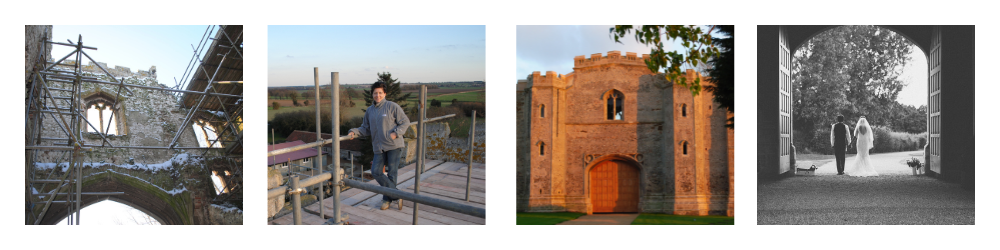
I have studied interior design and, over the years, I have had the privilege of renovating several period properties, including a full restoration of an 800‑year‑old abbey in West Norfolk – a Grade I listed building on the At Risk register, on a protected site, which we converted into both a home and a hospitality venue. That project, with all of its constraints and responsibilities, taught me just how complex it is to blend centuries of history with modern life and real‑world budgets.
At the same time, I kept seeing the same pattern with the women I worked with. They were in their forties or fifties, had moved a few times, accumulated furniture and possessions along the way, and had now finally arrived in a classic British home – a Victorian, a Georgian, a barn conversion, a period cottage.
They loved these houses deeply, but they were overwhelmed. How do you honour 200 or 300 years of architecture, use what you already own, avoid expensive mistakes, and still create a home that feels authentically like you?
The interior design world offered them two unhelpful extremes: aspirational images that start with a blank sheet, and fast‑moving trends that have nothing to do with their real lives.
I created the Home Style Archetype system because I wanted to give women a clear language for their own style, a framework for decision‑making, and a way of working with – not against – the period character of their homes.
The Real Problem: You’re Not Indecisive – You’re Missing A Language
If you recognise yourself in this description, you are not alone. By midlife, many of us have lived in several homes, bought furniture in different seasons of life, inherited pieces from relatives, picked up things on travels or at markets, and carried them all forward. Your current home is rarely a blank canvas. It is a patchwork of stories.
The problem begins when that patchwork moves into a classic British property. A Victorian terrace with its narrow hallway and strong chimney breasts. A Georgian townhouse with high ceilings and large sash windows. A long, low cottage or a barn with soaring beams and awkward corners. Suddenly, the furniture that felt “fine” in a new build or a flat feels wrong, lost or intrusive.
At the same time, your phone is full of images – exquisite hotels, perfectly lit kitchens, homes in magazines that are essentially sets built for a photoshoot. They are beautiful, but they are entertainment. They are not your reality. Trying to copy them exactly will always leave you slightly dissatisfied, because they were never designed for the way you live, in the building you inhabit, with the history you carry.
So you start to question yourself.
Maybe I’m just indecisive.
Maybe I don’t have “an eye”.
Maybe I have to throw everything out and start again.
No. What you are missing is not taste or intelligence. You are missing a language – a clear way to describe your own Home Style Signature, so that all your decisions can flow from who you are, how you live, and the house you live in. That is exactly what the Home Style Archetypes and the Home Mirror Principle are designed to give you.
Home As A Mirror – The Psychological Foundation
Every Home Style Archetype masterclass begins with the same idea: your home is a mirror.
It reflects how you live, what you value, how you rest, and what you believe you deserve. Sometimes that reflection is clear. Sometimes it is a blur of old habits, hand‑me‑downs and rushed purchases. But it is always telling the truth.
We accept this in other areas of life.
Your wardrobe is not random – it tells a story about comfort, confidence and how you want to be seen.
Your daily rituals are not random – the way you start and end the day reflects what you need in order to feel grounded.
Your interiors are not random - you already have psychological preferences. You are drawn to certain materials, shapes, colours and atmospheres. You may not have had the language to name them, but they are there.
The Home Mirror Principle™️ simply asks you to pause and look inward before you look outward. Instead of asking “What is in style right now?” we begin with “What feels deeply right for me and for this house?” Once you understand that, architecture, furniture choices and even trends become much easier to navigate. They either support that inner compass or they do not.
Why Trends Alone Will Never Build Your Forever Home
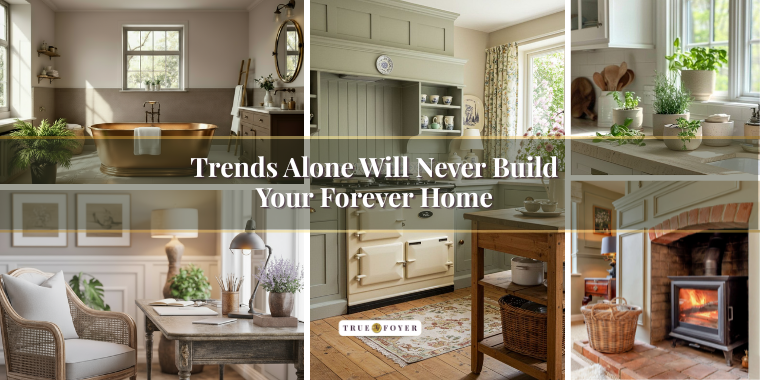
I am not anti‑trend. It would be unrealistic to pretend we are not influenced by what we see. New ideas, materials and palettes can be exciting and genuinely useful. The problem arises when trends become the starting point instead of the final filter.
The modern homeowner is bombarded with imagery – neutral Japandi kitchens one day; rich, patterned English country rooms the next; “all white everything” on Monday; moody, dark libraries on Friday. Scroll long enough and you will want them all. That is not because you are fickle. It is because trends are designed to seduce, and they are shown to you without the context of your life, your house or your accumulated possessions.
In a heritage home, the stakes are even higher. Many trends sit uncomfortably inside older architecture. A hyper‑sleek, anonymous kitchen that would work in a city penthouse can look harsh and slightly absurd in a Georgian farmhouse with deep window reveals and original beams. When you chase trends without a deeper structure, you end up with expensive mistakes that date quickly and never feel quite at home.
In the Home Style Archetype system, trends are allowed in, but only after they pass through two filters:
Do they align with your dominant and supporting archetypes?
Do they honour the A.R.C.H. Framework – Authenticity, Reflection, Character and Harmony?
When those answers are yes, a trend can become a fresh note in a timeless composition. When the answers are no, you can appreciate it on Instagram and happily leave it there.
Why Period Properties Add Another Layer Of Complexity
Older buildings are wonderfully stubborn. They have their own logic, their own proportions, their own way of handling light and sound. A Georgian room wants symmetry and balance. A Victorian terrace often wants clever use of smaller rooms, narrow hallways and strong focal points like fireplaces. Barns and cottages bring beams, quirky angles and deep shadows into the picture.
When we restored the abbey in West Norfolk, every decision had to answer three questions at once.
Does this respect an 800‑year‑old structure that is legally protected?
Does it allow modern life, including hospitality, to function smoothly?
Does it feel emotionally coherent – not like a museum, not like a theme park, but like a living, breathing home?
Now, your house may not be on the At Risk register, but the tension is the same. You cannot erase the architecture. Nor should you want to. The cornicing, the sash windows, the brick or stone, the proportions – these are the gifts of a period home. They deserve to be in conversation with your furniture, not drowned out by it.
That is why the Home Style Archetype system always considers three layers together:
Who you are (your archetypes and psychology)
What you own (your existing possessions and budget)
Where you live (your architectural context and period features)
When those three layers are aligned, design becomes less about imposing a look and more about revealing and refining what already wants to be there.
Introducing The Seven Home Style Archetypes
So what exactly is a Home Style Archetype?
In simple terms, it is a personality profile for your home – a cluster of preferences around materials, shapes, colour, atmosphere and emotional needs. Over years of studying interiors, working on period projects and observing real British homes, I noticed the same patterns repeating.
The furniture we buy, the objects we keep, the images we save – particularly here in the UK – tend to fall into seven broad, recognisable groups. I gave those groups names, so that you can talk about them easily and see them clearly when you walk through your rooms or scroll online.
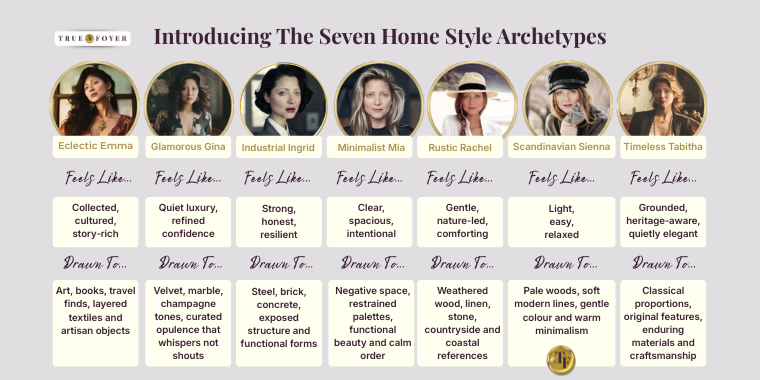
These archetypes are not made‑up themes for the sake of it. They are a way of grouping what already exists in most British homes and shops, so that you can see patterns where there once seemed to be chaos. They help you understand why you instinctively love certain rooms, and why other rooms – even if they’re “beautiful” – never quite feel like you.
Why Most Women Are A Blend (And Why 2–3 Is Enough)
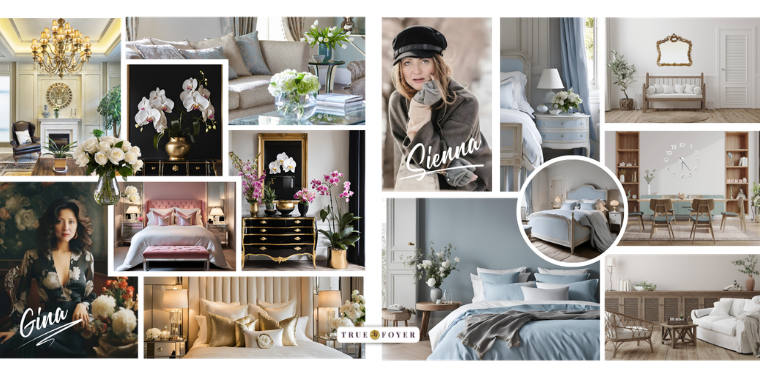
Very few women are a pure, single archetype. Most of us carry a blend of influences. You might be primarily Timeless Tabitha, with a strong streak of Rustic Rachel and a dash of Minimalist Mia. Or you might be Glamorous Gina with Eclectic Emma and a little Scandinavian Sienna in the mix.
The quiz is designed to reveal your dominant archetype and then one or two supporting archetypes. That is intentional. A family home reads best when it is composed of two or three clear voices that harmonise, not five or six all competing for attention.
There are exceptions. In a large house with distinct “theme” rooms, or in a hotel or bed and breakfast, you might deliberately play with more archetypes. But for most homes, two to three are ideal. You get richness without confusion. Variety without chaos.
The system also discourages you from chasing every style you have ever liked on Pinterest. Instead, it invites you to say, “These are the two or three archetypes that genuinely belong to me and to this house. Everything else is just visual noise.” That is incredibly freeing.
The A.R.C.H. Framework™️ – The Part That Quietly Changes Everything
Knowing your archetypes is a powerful start, but it is only half the system. The other half is how you actually make decisions with that knowledge. This is where the A.R.C.H. Framework ™️ comes in.
A.R.C.H. stands for Authenticity, Reflection, Character and Harmony. Every masterclass is built around these pillars, and they are as much about your values as they are about your furniture.
Authenticity
Authenticity asks: “Is this choice true to me and to this house?”
That means:
no cheap, passing trends that have nothing to do with your life or your architecture
quality over quantity wherever possible
a preference for craftsmanship, honest materials and pieces that will age well rather than fall apart
Authenticity has an ecological dimension too. It asks where something was made, how, and whether it deserves a place in your home for years, not just for one season.
Reflection
Reflection asks: “Does this space reflect how we actually live, not how a magazine thinks we should live?”
It is about usefulness and purpose.
Does the dining room really want to be a dining room or is it quietly functioning as a study?
Does that armchair get used, or is it just there because you feel it “should” be?
Reflection is about aligning rooms, layouts and objects with the real rhythms and energy of the people who live there.
Character
Character asks: “What gives this home its soul?”
Here we are talking about:
one‑off special pieces and collectibles
meaningful heirlooms, precious photographs and mementos
items with a story, with a maker’s hand visible, with patina or history
Character is what keeps a home from becoming a showroom. It is also why you do not need to throw everything out and start again. Many of your most characterful pieces are already in your house. They may simply need a new frame, a better backdrop or a clearer context.
Harmony
Harmony asks: “How does everything work together?”
It is about proportion, ratios and relationships. A simple rule I use often is 60 / 30 / 10:
60 percent for your dominant archetype
30 percent for your main supporting archetype
10 percent for a third accent archetype or a small contrasting note
The same ratio can guide colour palettes, pattern mixes, textures and even volumes or statement pieces. Harmony ensures that each element plays its part without shouting over the others.
When you apply A.R.C.H. consistently, your home starts to settle. Decisions become easier, because each choice either supports the framework or it does not.
The Archetype Quiz – Why It’s Deliberately Slow
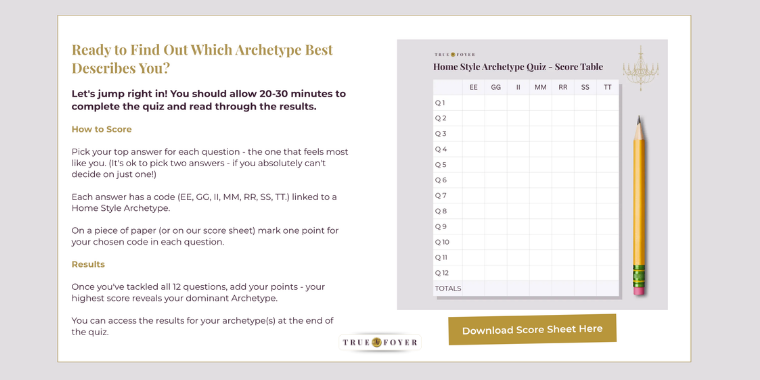
In a world of three‑second quizzes and disappearing options, the Home Style Archetype quiz is intentionally old‑fashioned. It is a manual, pen‑and‑paper experience on purpose.
I want you to:
Make a cup of coffee
Print the score sheet or take a piece of paper
Move slowly through the questions
See all the options in each drop‑down, not just the one you tapped first
This is not about ticking boxes as fast as possible. It is about noticing your reactions. Which images or descriptions keep pulling you back? Which answers feel “almost right” and which feel like home?
By the end, you will normally see one archetype come through clearly, and then one or two close seconds. It is not about squeezing you into a box. It is about giving you language. Suddenly, “I like calm rooms but I also collect old pottery and books” becomes “I’m primarily Minimalist Mia with a good dose of Rustic Rachel and a hint of Eclectic Emma”, and that language is incredibly practical when you move on to making design decisions.
You Do Not Have To Throw Everything Out
One of the most harmful myths in interior design is the idea that you must start again to “get it right”. New house, new life, new furniture. That might be an option for a show home or a shoot, but it is neither necessary nor desirable in a real, lived‑in property – especially a period one.
In my own home, and in my work with clients, the process begins with what is already there. We look at each item carefully and ask a series of honest questions:
Do I genuinely love it?
Does it align with my dominant or supporting archetypes?
Does it simply need some care – a repair, repainting, reupholstering or reframing – to look wonderful again?
Will it last many more years and continue to look good?
Does it have meaningful sentimental value, not just guilt attached to it?
Does it perform a useful function in how we live now?
Where does it sit in my 60 / 30 / 10 blend – is it contributing to the right archetype in the right proportion?
Is it the best example of that category I own, or is there another piece that deserves the space more?
Does it harmonise easily with the other things I have chosen to keep?
We keep purposefully. We do not hoard. There must be breathing room in every corner, vignette and room. But we keep. We honour. We reframe and restore. The goal is not to empty your home. The goal is to uncover the best of what you already own and give it a context in which it can shine.
When you apply this lens through your archetypes and the A.R.C.H. Framework ™️, something lovely happens. The things that belong become clear. So do the things that do not. Letting go becomes easier because you can see exactly why a piece is fighting the story you want your home to tell.
Your Home Does Not Have To Look Like A Magazine Spread
The second myth is that a “good” home must look like something from a glossy feature. Perfectly styled, immaculate, impossibly tidy, a little bit anonymous.
I love beautiful photography. I love a well‑styled image. But real homes are not sets. Children live in them. Dogs. Friends who turn up with muddy boots and red wine. Real homes hold real life.
When you design your home purely to look like a magazine spread, you often strip out exactly what would have made it feel right. Comfort. Quirkiness. Evidence of use. Objects that matter deeply to you but would never make it onto a mood-board for a campaign.
The irony is that when you apply the archetypes and the A.R.C.H. Framework properly, your home does end up looking wonderful in photographs – often more compelling than a staged shoot – but for the opposite reason. It photographs well because it is interesting, authentic, layered and warm, not because it has been engineered for the camera.
Spaces that are true to their owners have a special energy. They feel inviting in person and they read beautifully on screen. That is the sweet spot we are aiming for.
What You’ll Find Inside The Home Style Archetype Masterclasses
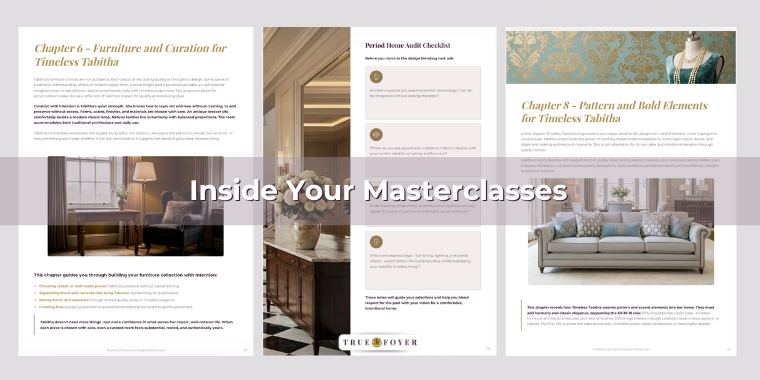
The quiz gives you your language. The masterclasses give you the roadmap. Each one is a full design toolkit created for a specific archetype, and they are deliberately rich in both philosophy and practical steps.
A Deep Understanding Of Your Archetype
Every masterclass begins with:
A detailed description of the archetype’s essence and emotional needs
The Home Mirror Principle as it relates to that archetype
The A.R.C.H. Framework tailored to her values
You’ll see yourself in the “Is this you?” worksheets – simple tick‑box and reflection prompts that help you confirm whether this archetype really does describe you.
Core Design Principles And Checklists
Each guide then moves into the foundations of design for that archetype, using clear, accessible language:
Core colour palettes and how to apply them
Guidance on space planning and flow
How to use focal points in a way that suits that archetype’s temperament
Key materials, textures and patterns that feel “at home” for her
Alongside the teaching, you have room clarity checklists and other practical tools to help you audit your existing rooms. You are not left guessing. You can stand in your sitting room with the checklist in hand and work through it step by step.
Lighting, Furniture, Accessories And Rooms In Detail
Rather than leaving you with vague ideas, the masterclasses go category by category:
Lighting – how to layer ambient, task and accent lighting in a way that suits your archetype’s mood and your period architecture
Furniture – what shapes, materials and scales to prioritise, and how to edit what you already have
Accessories and styling – how much is enough, how to build vignettes, what to avoid
There are also chapters on designing specific rooms – from entrance halls to bedrooms – with prompts and planners so you can translate the philosophy into concrete plans.
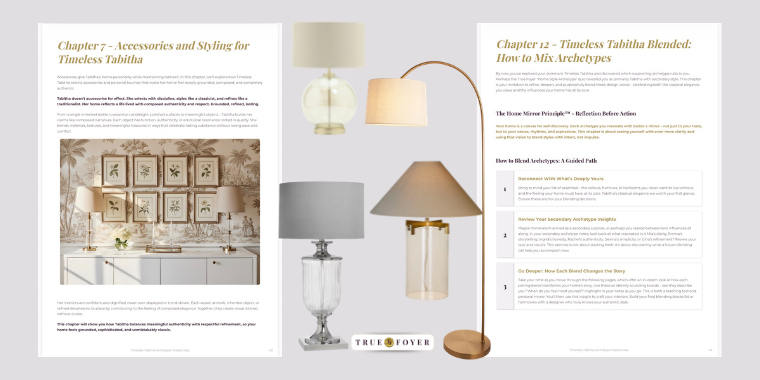
Blending Tools And Ratios
Every masterclass includes a blending chapter. This is where you learn how your dominant archetype interacts with the others – what happens when Minimalist Mia meets Glamorous Gina, or Rustic Rachel meets Timeless Tabitha.
You’ll find:
Detailed descriptions of how each pairing feels
What to add and what to avoid in each blend
Simple tables that summarise “who she is”, “looks like”, key elements from each archetype and prompts for building your own blending blocks
This is where the 60 / 30 / 10 ratios become very practical. You can literally see how to layer your dominant and supporting styles so that each is visible but none is overpowering.
Sourcing Lists, Designers And Inspiration
Finally, each masterclass offers curated resources:
Designers and architects whose work resonates with that archetype’s values
Brands and makers to look at for furniture, lighting, textiles, ceramics and more
Books and online platforms that will deepen your understanding and give you sustainable inspiration
These are invitations, not prescriptions. They are there so you can refine your eye and build a small, trusted circle of references that align with your archetype, rather than disappearing into endless search results.
Because most women are a blend, the 3‑for‑2 masterclass offer is very intentional. You invest in your dominant archetype and your two supporting ones, and you end up with a comprehensive design toolkit for your entire home – tailored to you, not to a generic trend.
Archetypes, A.R.C.H. And Your Architecture – Working Together
To see how this plays out, imagine a typical scenario.
You have just moved into a Victorian terrace. There are fireplaces, original skirting boards and some slightly battered floorboards. Your existing furniture is a mix of pieces from previous homes, hand‑me‑downs from family and a few trend‑led purchases. You have folders full of screenshots ranging from minimal white interiors to maximalist patterned rooms.
You take the quiz, notebook in hand. You discover that you are primarily Timeless Tabitha, with Rustic Rachel and Minimalist Mia as strong supports. Suddenly, the noise quiets. You have words. You purchase those three masterclasses using the 3‑for‑2 offer, and you sit down with a pen and the Home Philosophy pages.
You begin in the sitting room:
You use the Room Clarity Checklist to assess breathing room, focal points, colour, materials and emotional alignment.
You look at each piece of furniture and ask the questions about love, archetype alignment, longevity, sentiment and function.
You make a list of what needs to be repaired, repainted or reupholstered, and what quietly needs to leave.
You apply the 60 / 30 / 10 idea – perhaps 60 percent Timeless Tabitha (architecture, main furniture pieces), 30 percent Rustic Rachel (materials, textures, textiles) and 10 percent Minimalist Mia (negative space and restraint).
You are no longer asking “What would look good on Instagram?”. You are asking “What would make this room feel grounded, calm, nature‑connected and quietly elegant for us, in this house?”.
The same process then moves through the rest of the home. Over time, you build not just a beautiful interior, but a coherent, deeply personal one.
Why This Matters More Than Ever
Since the Covid years, many of us spend more time at home than ever before. Homes are offices, classrooms, retreats and social spaces. At the same time, the housing market has shifted. People are moving less often. Rather than trading up every few years, more of us are choosing to stay and invest in what we have.
In that context, it makes far more sense to renovate thoughtfully once than to endlessly shuffle houses and replace things on a whim. Taking the time to understand your archetypes, your architecture and your values before you design is not indulgent. It is practical.
There is also an ecological dimension. Every time we chase a trend and then tire of it, we create waste – financially and environmentally. When we support local craftspeople, invest in quality and choose pieces that will age well, we reduce that churn. When we reframe a painting instead of discarding it, commission a local carpenter instead of buying a flat‑pack import, we are not just decorating. We are preserving stories and skills.
Above all, home has become sanctuary. After the upheavals of recent years, our houses need to support our nervous systems as much as our schedules. They need to feel safe, honest and aligned, not performative. A home created through the lens of your archetypes and the A.R.C.H. Framework will always feel more supportive than one assembled purely for show.
Your Next Steps
If any part of this has resonated with you, here is where I suggest you begin.
Set aside an hour for yourself. Make a coffee or tea. Print out the ➡️ Quiz Score Sheet HERE ⬅️ or grab a notebook. Take the ➡️ Home Style Archetype Quiz ⬅️ slowly, noticing what you are drawn to and what you resist.
Note your dominant and supporting archetypes. Trust the resultLet it give you language for what you have always loved.
Choose your masterclasses. Start with your dominant archetype and then add your two strongest supporting ones using the ➡️ 3‑for‑2 Archetype Offer ⬅️ . That combination will give you a complete, highly practical road map for your home.
Begin with one room. Use the Room Clarity Checklist, the Home Philosophy pages and the blending guidance to work through it slowly. Ask the honest questions about every piece you own. Allow yourself to keep what is worthy and let go of what is not.
Join me for future archetype workshops. If you add yourself to my email list, you will be the first to know when I run live online workshops where we apply the archetypes and A.R.C.H. Framework together, room by room.
You do not need a blank slate. You do not need a show home. You need a clear understanding of who you are, the home you live in, and a system that translates that into tangible decisions. That is why I created the Home Style Archetypes - so that women who care deeply about their homes, especially in period properties, can create spaces that feel like a symphony instead of a struggle.
As you imagine your own home a year from now, what would you most love to feel when you walk through the front door – calm, uplifted, grounded, quietly proud, or something else entirely?
